Tag Archives: Palouse

Backup for peace of mind

Barn at Sunset by Gary Hamburgh - All Rights Reserved

Barn at Sunset by Gary Hamburgh - All Rights Reserved

As a photographer you are always being told to backup your files because your storage media will fail at some point. A good plan is so essential as I found out yesterday afternoon.

One of my 1 Tb external hard drives failed with no warning. On that drive was a 930 gig Aperture library with thousands of images. Fortunately I had just backed up that library the night before to an Aperture vault that I have on a Drobo storage device with four 1 Tb drives. I was able to restore my library to a new 1 TB drive that I had not been using. It took approximately 13 hours to complete the restore but at least I was able to recover the data.

I have always been concerned about a failure and am very glad that at least I have one level of backup that was helpful. This near disaster has gotten me to thinking that maybe I need a more complete plan than I currently have in place.

Here is a link to an article Backup In Progress by Any Ihnatko that talks about making a backup plan. This is just one such article on an extremely useful website mydl.me that is hosted by Scott Bourne and Andy Ihnatko.

Follow Scott on Twitter – http://www.twitter.com/scottbourne

Follow Andy on Twitter – http://www.twitter.com/ihnatko

I hope you will take their advice and also learn from my experience that a good backup plan is essential because at some time it will save you from disaster.
Simplicity can be dramatic

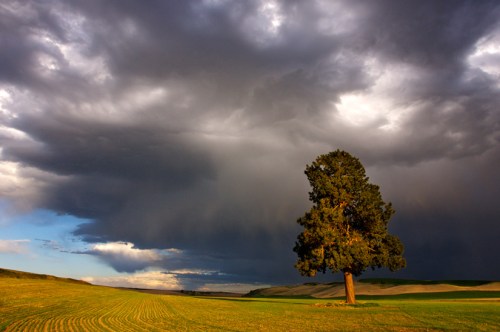
Storm Clouds over Lone Pine by Gary Hamburgh - All Rights Reserved

Storm Clouds over Lone Pine by Gary Hamburgh - All Rights Reserved

One of my favorite towns in the Palouse region is St. John. This small town is located on Hiway 23 about 2o miles from the town of Steptoe. The main reason I enjoy passing through this town is because of a large pine tree that grows in the middle of an open field as you leave town traveling southeast. The tree is solitary and appears to dominate the landscape.

Once as I was passing through the town the sky was very dark with a pending thunder storm but the field and tree were being illuminated with the evening sunlight. The simplicity of this lone tree and the dramatic contrast with the stormy sky provided my eyes with a feast. As I captured the image and viewed it later, I realized the simplicity in elements is what made this image come together for me.

As you travel through St. John, hopefully you will have the same connection with this large solitary tree that I have experienced

Farming by Air

Swooping In by Gary Hamburgh - All Rights Reserved

Swooping In by Gary Hamburgh - All Rights Reserved

One of the things I enjoy seeing in the Palouse are the crop dusting planes as they maneuver their way around the fields. Much of the fertilizer and chemicals are applied with this method.

In the photo at the top of this page, you see a pilot getting into position to dispense a load of dry fertilizer onto the terrain. I had talked with this pilot at a small airstrip near Colfax a few minutes earlier. He had given me directions to get into a position where I could observe him doing his work.

Generally the times you will see the planes applying the chemicals is in the early morning as the air is usually calmer at that time. If you want to watch a form of aerial acrobatics being put to good use in the farming process, travel to the Palouse and enjoy.

Farm equipment adds to the composition

Patterns of Harvest by Gary Hamburgh - All Rights Reserved

Patterns of Harvest by Gary Hamburgh - All Rights Reserved

I have found that while photographing the contours, patterns and textures in the Palouse, it can be interesting to include some of the machinery that helps to create the landscape. Just including a tractor or combine during harvest can tell a completely different story.

The picture above shows a combine at work during the wheat harvest. It always amazes me as I watch the very steep terrain these harvesters are capable of negotiating. Notice the dust that is present in the image. Areas where farming takes place are usually dusty so be ready to protect your equipment as you are shooting. Also wear boots as many times you may sink in above your ankles in the dirt as you walk the terrain.

I generally try to talk with the farmer or driver of the combine and ask a few questions to show interest in what they are doing. Many times they will ask me if I would like to look inside or I have even been given rides at times in the cab. This gives a completely different view that most people don’t have the opportunity to see.

To give you an idea many of these combines have a system that allows the cab to remain level no matter what the terrain. In addition the newer ones have electronics on board that give critical information such as the number of bushels per acre that is being harvested. The information can be downloaded later onto a computer. Of course air conditioning and music are available as well. If you get the opportunity to visit the area, interact and you may enjoy a ride as well.

As you travel the Palouse look for opportunities to utilize the farm machinery whether it is new or old, working or just standing idle in a field. These large pieces of equipment can add a new story to your images about the work that takes place in the creation of these artistic vistas of farmland that we enjoy.

Housecleaning can be valuable

Evening Light in the Palouse by Gary Hamburgh - All Rights Reserved

Evening Light in the Palouse by Gary Hamburgh - All Rights Reserved

It seems to me one of the hardest things for photographers to do is to edit our own images. With the lower cost of storage space, it is easier to buy a new hard drive than it is to actually delete images. I have had several people tell me that they don’t get better sitting on your hard drive.

With this suggestion in mind, I took on the task of sorting through images reevaluating and deleting  what I have stored. In so doing I was able to clear some valuable hard drive space.  Even more important to me I found several images that I had taken last year that I had not even evaluated. The image at the top of this page is one example of what I found. The task of evaluating actually turned out to be fun as I was able to see the possibility of these images being of value to me.

Keep in mind that housecleaning can be great for gaining space as well as finding images that you definitely need to reconsider. I guess the final thought would be evaluate, delete, edit and gain.

Clouds – important compositional element

Road to the Clouds by Gary Hamburgh - All Rights Reserved

Road to the Clouds by Gary Hamburgh - All Rights Reserved

When shooting in the Palouse there are many opportunities to use the leading lines and curves of the terrain for your composition.  A dramatic or colorful sky can help to balance the composition. I always enjoy days with blue sky and white “puffy” clouds.

I would like to suggest using the clouds as a major compositional element in the background. The image at the top of this page shows an example of using the clouds as a main element of the composition. Let me explain my thought process as I created this image.

I was driving along HIghway 195 from Pullman to Colfax whenI noticed the dirt road in the field and thought the lines and colors were interesting.  At that time there was just a clear blue sky above the landscape. I kept driving for a ways when I noticed some clouds moving to that area from the southwest. I turned around and decided to see if the clouds would move into the setting I had seen before.

As I parked by the side of the road, it was evident that the clouds were definitely moving rapidly toward my position. I set up my tripod and camera and just waited as the cloud formation continued to approach. At times I try to name an image before I actually shoot. This helps me to visualize and create the image in my mind.  The funnel shaped cloud formed just before it reached my position and I thought if it would line up with the dirt road I would be able to capture the image I had imagined. I took a couple of shots just to check my exposure and as the funnel reached the top of the road I pressed the shutter and the image was mine.

This image was effective for me because I utilized the clouds as a main compositional element. Using the clouds allowed the road to lead to something of interest.  Think creatively about the clouds in your photos and see the added impact they can provide.

Getting Images Tack Sharp

Barn in Morning Light by Gary Hamburgh - All Rights Reserved

Barn in Morning Light by Gary Hamburgh - All Rights Reserved

When shooting a landscape most of the time it is essential to get everything in the image from foreground to background in sharp focus. This can be difficult to accomplish. Many lenses have their sweet spot at apertures f8 or f11. However to achieve a greater depth of field a smaller aperture like f22 would be useful.

An article entitled Tack-Sharp Images by Joe Johnson, the owner of Really Right Stuff, caught my attention. He discusses the issues and procedures for achieving sharp focus throughout the image. I enjoyed his discussion and suggestions and hopefully you will find the article informative and useful as well.

Utilize Local Resources


Afternoon Sun Lights Barn by Gary Hamburgh - All Rights Reserved

Afternoon Sun Lights Barn by Gary Hamburgh - All Rights Reserved

When visiting either a new or even a familiar region to photograph, I have found it very useful to connect with local residents. The locals will have a knowledge and understanding of the area that has been developed through their experiences of living and working there. This is especially true in the Palouse as many of the residents living in the small towns have roots to the area for three or four generations.

This past week, I spent time in the Palouse region mainly around the towns of Colfax and Pullman. I made several connections with local people that will prove to be of value to me as I increase my portfolio of images in that region. 

One day I went to a small cafe around lunch time and just interacted with several of the locals that were enjoying their dinner. By the time I left I had made several new acquaintances and also had the directions to a couple of barns that I had not seen before. In addition they suggested another individual who proved to be very useful in my search for old barns to photograph around that area. We ended up spending almost 2 hours together as he drove me around in his pickup to back country areas to look at barns. I ended up with his phone number and he said contact him anytime and he would be happy to help me explore once again.

Remember, getting to know the people as well as the area can be a very rewarding experience. Spending time interacting and asking a few questions about their town, work environment and the people living in the region will give you a new perspective of the area.

Prepare for the Unexpected

Mule Deer Trio by Gary Hamburgh - All Rights Reserved

Mule Deer Trio by Gary Hamburgh - All Rights Reserved


Preparation is a key when going on a photo shoot. Gear should be checked to make sure the cameras, lenses, tripod, extra batteries, flashes, cards and any other miscellaneous equipment is packed and ready for use. Upon arrival at the location the appropritate combination of equipment is set up to prepare to make the image we have been planning and visualizing.

It is also important to be prepared  for the image you may have the opportunity to capture as you travel to the location. While traveling by car, I always have a camera body with a lens attached to it  sitting on the seat next to me. I have found that many times an unexpected opportunity to capture a unique shot presents itself and I want to be prepared. The image seen above was just such an opportunity.

While traveling along a gravel road in the Palouse region of eastern Washington I came around a blind corner and this threesome was standing there to greet me. I picked up the camera and carefully rolled down my window and was able to take a series of images without scaring the deer trio into flight. Many times an animal or bird will stay to be photographed if you remain in your car.

As I prepare for this kind of opportunity I have the following equipment ready. My Canon 1D Mark III equipped with a Canon 100-400mm IS zoom set to ISO500,  f5.6  at 400mm is ready for immediate use. Generally I have it set for 10 fps in AI focus mode. Through some trial and error I have found that this combination of equipment and settings prepares me for just about any wildlife situation that I may want to photograph from the car. The equipment is light enough to hand hold and the settings allow for a fast enough shutter speed to stop motion.

There are undoubtably many methods and combinations of equipment that can be effective for these unexpected opportunities. My experience tells me be prepared and you may be rewarded.

Changing Your View Gives New Perspective

As photographers sometimes we get stuck in the same mode of shooting images. The standard position we normally shoot is either from a tripod or hand held at eye level. This practice can produce shots that may look very ordinary and tell the usual story.

Typically in the Palouse region miles of wheat fields are viewed either from our car or as we walk along.  This view is from above and we see the landscape as a vast sea of grain stretching to the horizon. I don’t mean to imply that this view can’t provide a beautiful vista but there are other views that can create interest as well.

Reaching for the Sky by Gary Hamburgh - All Rights Reserved

Reaching for the Sky by Gary Hamburgh - All Rights Reserved

To add a different perspective to your work, try exploring new vantage points for creating an image. In the image above, I was putting myself in the position of a small rabbit that I had observed just moments earlier. The wheat through his eyes must appear to be a tall forest of grain “reaching for the sky”. That forest of grain gives the small creatures shelter and protection as it fills up their landscape. To me this tells a completely different story as the wheat provides a purpose that we don’t normally consider.

Remembering to change your view may add a totally new perspective to your shooting.  Shoot high, shoot low, shoot from all around and give your images a new and refreshing look.