Tag Archives: Palouse

Between Seasons


I enjoy photographing the Palouse at any time of the year, but the time between seasons can give some interesting views. My favorite transition occurs between winter and spring. The beauty of the winter lingers as the anticipation of the spring and a newness is evident. 

In the image below one can see the patterns in the snow that were left by a rain the day before. This was taken on a very cold morning in late February just after sunrise when the temperature was 18 degrees. 

Snow Patterns surround a Barn by Gary Hamburgh - All Rights Reserved

Snow Patterns surround a Barn by Gary Hamburgh - All Rights Reserved

This is one of my favorite barns in the Palouse. It is located about five miles from Colfax, Washington. Just remember when you are planning a trip to the Palouse, look at a time that is not considered to be the prime season and you may be treated to a different perspective of this region.

Using What’s Left

One of the things that is intriguing about photographing the Palouse is sometimes you make a photograph of something unexpected. Generally as images are captured in this region, we see rolling hills, lush wheat fields or abundant harvests. I like to look for what I call unusual remnants that may be left after the harvest is over.


River of Wheat by Gary Hamburgh - All Rights Reserved

River of Wheat by Gary Hamburgh - All Rights Reserved


The image above gives just that kind of perspective. The harvest is finished and the field is plowed and planted. You can see where the winter wheat is starting to show through. The focus of this image is the leftover wheat that was not harvested because it was in a shallow gully that the combine could not reach. As I came around a corner looking for a fertile landscape, this patch of wheat reminded me of a river that was running to the grain storage shed in the distance. The starkness of the plowed field helped to emphasize the wheat river.

As you travel the Palouse be attentive looking for something that is not always expected. Look beyond the ordinary and make an image that is different and interesting.

Converting Images to B&W


Converting an image to black and white can create a different mood and sometimes add more drama to a scene. Many of the images you capture in the Palouse can be very effective utilizing this conversion process. I really enjoy converting images that have barns and a strong contrast between the sky and the rest of the scene.
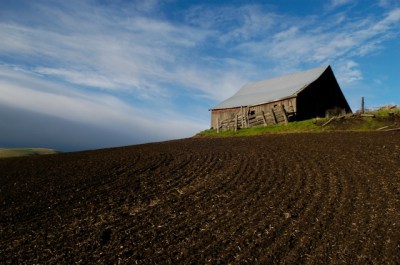
 

Morning Glow on Barn by Gary Hamburgh - All Rights Reserved

Morning Glow on Barn by Gary Hamburgh - All Rights Reserved


The barn pictured above was the color image that I used to create the black and white conversion. The color version had been adjusted in Aperture to depict what the scene looked like as I captured it.

A great product that can be used for black and white conversions is Silver Efex Pro by Nik software. For my workflow it is the simplest and most effective conversion tool that I have found. The procedure that was used to create the black and white conversion follows.

In Aperture, I selected the Nik software plugin for Silver Efex Pro.  When the image opened I selected the high structure preset and added a red filter.  Slight adjustments were made with the sliders until the conversion was to my liking. The entire conversion process took about fifteen seconds. The original conversion is shown below.
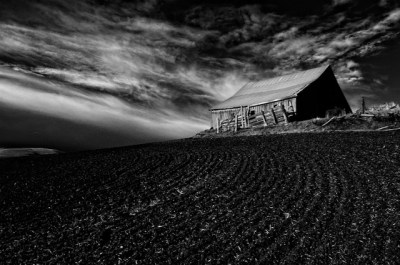
 

Morning Glow on Barn b&w

Morning Glow on Barn b&w by Gary Hamburgh - All Rights Reserved

Afterwards the image ws cropped to bring the barn into the foreground and let the sky become more prominent. Each version tells a little different story. The full version with the leading lines of the furrows shows the impact of farming in the photo. The cropped version emphasizes the drama of the sky.
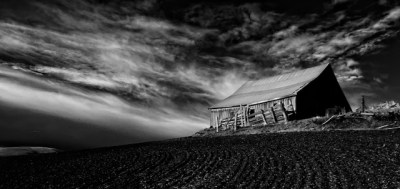
 

Morning Glow on Barn b&w crop

Morning Glow on Barn b&w crop by GAry Hamburgh - All Rights Reserved

The Palouse with its landscapes allows you to experience very dramatic and inspiring vistas. Hopefully this idea of converting images to black and white will help you to share a different perspective with others as you explore this area of eastern Washington.

Changing Faces of the Palouse


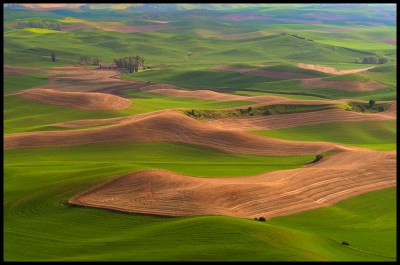
View from Steptoe Butte

View from Steptoe Butte by Gary Hamburgh - All Rights Reserved

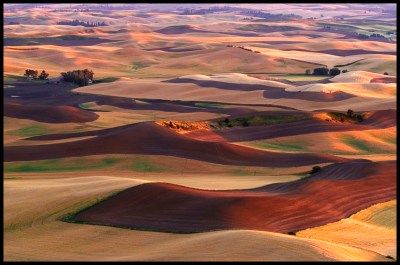
Chocolate and Caramel Mounds

Chocolate and Caramel Mounds by Gary Hamburgh - All Rights Reserved


Photographing the Palouse can be very rewarding if you go back to capture the same image at a different time. That familiar scene has a completely different look due to a change in colors and textures. These changes may be a seasonal change or because of cultivating and harvesting the land. As you revisit, it exciting to see the the subtle as well as the bold transformations that have taken place.

The two photos above were taken from the same location on Steptoe Butte during the same calendar year. The first photo “View from Steptoe Butte” was taken in May and the second “Chocolate and Caramel Mounds” was taken in July. They both show common elements as well as major differences. This seasonal change is very dramatic and can provide you with a new vision as you explore the Palouse .

Remember when shooting the Palouse, retrace your steps and be rewarded a second time.