Category Archives: Photography Advice

Make your Images into Products

 A Deere against the Sky - Copyright Gary Hamburgh 2009 - All Rights Reserved

A Deere against the Sky - Copyright Gary Hamburgh 2009 - All Rights Reserved

I am going to share this great post entitled “Want to go Pro? Productize Your Work” by my friend and mentor Scott Bourne. Be creative in putting your images into a product.

Visit the Palouse and share your great images with the world on a collection of products.

Choose your Combine by Color

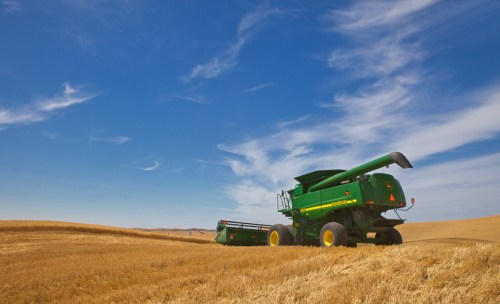
John Deere Combine 1 by Gary Hamburgh - All Rights Reserved

John Deere Combine 1 by Gary Hamburgh - All Rights Reserved

When shooting harvest in the Palouse not only are you treated to some beautiful landscape, but the various colors of the farm equipment adds to your images.

John Deere Combine 2 by Gary Hamburgh - All Rights Reserved

John Deere Combine 2 by Gary Hamburgh - All Rights Reserved

John Deere combine 3 by Gary Hamburgh - All Rights Reserved

John Deere combine 3 by Gary Hamburgh - All Rights Reserved

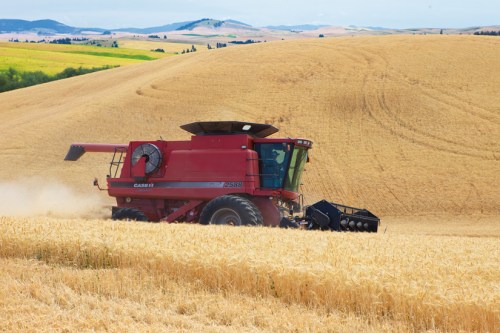
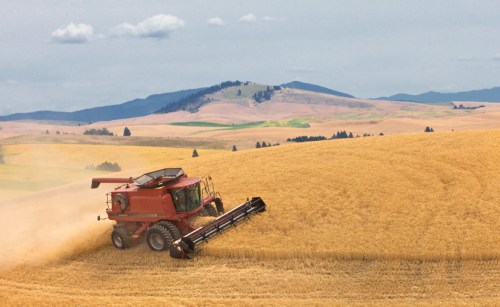
In this post I am going to mainly just share images with you that were taken during the wheat harvest last week in the Palouse. The harvests showing the John Deere and Case combines were shot near Steptoe Butte. Each of the growers that was using these two brands was harvesting between 8500 and 10,000 acres. These are large operations and involve several combines and trucks at each location.

Case IH Combine 3 by Gary Hamburgh - All Rights Reserved

Case IH Combine 3 by Gary Hamburgh - All Rights Reserved

Case IH Combine by Gary Hamburgh - All Rights Reserved

Case IH Combine by Gary Hamburgh - All Rights Reserved

Case IH Combine 1 by Gary Hamburgh - All Rights Reserved

Case IH Combine 1 by Gary Hamburgh - All Rights Reserved

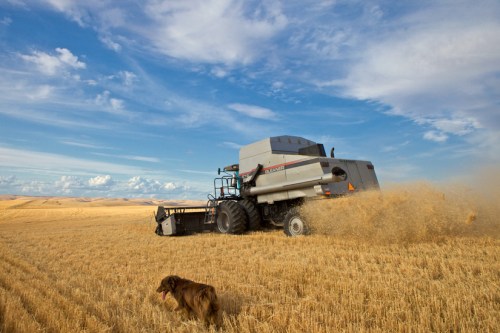
The harvest showing the Gleaner equipment was shot near Dayton, WA. They were harvesting only 4500 acres and using two combines. In this process a tractor pulls a wagon up to the high country where the grain is emptied then the tractor pulls the wagon down to where it is loaded in a truck.

Gleaner Combine 2 by Gary Hamburgh - All Rights Reserved

Gleaner Combine 2 by Gary Hamburgh - All Rights Reserved

Gleaner Combine 1 by Gary Hamburgh - All Rights Reserved

Gleaner Combine 1 by Gary Hamburgh - All Rights Reserved

Gleaner Combine 3 by Gary Hamburgh - All Rights Reserved

Gleaner Combine 3 by Gary Hamburgh - All Rights Reserved

The dog in the last picture belongs to the man driving the combine. He runs with the combine all day, every day during the harvest.

Try to get to the Palouse to photograph the harvest. It is a colorful scene and very interesting to observe. Hopefully the images in this post let you experience some of the process and scenery that is involved during the wheat harvest.

Protecting Your Gear in Dusty Conditions

Combine Kicks up Dust by Gary Hamburgh - All Rights Reserved

Combine Kicks up Dust by Gary Hamburgh - All Rights Reserved

I recently spent the last week shooting wheat harvest in the Palouse area near Colfax, WA. It was a great experience and the scenery was terrific. I quickly became very much aware that I needed to protect my camera gear from the dust that is kicked up by the combines.

The best way to protect your gear in these dusty conditions is with the rain covers you use when you shoot in the rain. They will also protect and keep dust off your gear. I have rarely been in conditions with the extreme dust and chaff that is surrounding you continually. Another word of caution, don’t get directly behind the combine as they are spewing out excessive amounts of dust and chaff whenever they are cutting. In addition to protecting your gear wear something to cover yourself as well because you will be extracting dirt and straw from your person for quite a while if you don’t.

Dust and Chaff in the Air by Gary Hamburgh - All Rights Reserved

Dust and Chaff in the Air by Gary Hamburgh - All Rights Reserved

In the images that are displayed in this post hopefully you get the idea of the dust and debris that is present. Have a great time shooting the harvest but be prepared so you and your gear can have a more enjoyable time.

Cloudy day can add vibrance to colors

Railroad Bridge in Palouse by Gary Hamburgh - All Rights Reserved

Railroad Bridge in Palouse by Gary Hamburgh - All Rights Reserved

The idea that prompted me to write this post was taken from a short video by Scott Bourne who talked about shooting on a cloudy day. Many times the skies are not what we would like to include in the image so don’t.

An advantage of shooting on a cloudy day is that the sky acts as a giant diffuser. This controls the normal midday harshness and provides a softer more flattering light. With this softer light colors become more vibrant. In the photo at the top of this post, you can see the effect of the softer light even though this image was taken near midday.

This railroad bridge is near the entrance to the town of Palouse coming from Colfax, WA. I was standing on a bridge that is the main road into town as I took the photo. It is a convenient place to shoot as there is a place to park and you can shoot the creek from either direction.

Remember on a cloudy day be prepared for some beautiful, vibrant colors in your images due to the soft, diffused light.

Lentil Harvest in the Palouse

Lentil Harvest in the Palouse by Gary Hamburgh - All Rights Reserved

Lentil Harvest in the Palouse by Gary Hamburgh - All Rights Reserved

Harvest has finally begun in the Palouse. Everything is several weeks later than normal but a visit now will allow you to see the harvest in full swing. Farmers work long hours each day to get the fields cut and the seeds into storage. In addition to the cereal crops of wheat and barley, lentils are also grown and harvested in the Palouse region.

Patterns of Rows by Gary Hamburgh - All Rights Reserved

Patterns of Rows by Gary Hamburgh - All Rights Reserved

Palouse farmers generally harvest lentils by mowing and swathing, or they may combine the crop. Swathing is often necessary to kill green weeds and allow them to dry so the lentils can be threshed efficiently. Plants are usually swathed when the pods turn a cream to golden color; then older pods will be dry and their seeds firm.
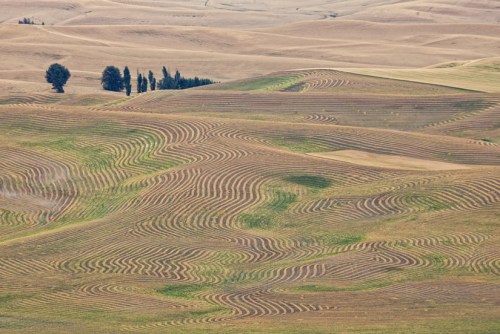
Lentil Patterns by Gary Hamburgh - All Rights Reserved

Lentil Patterns by Gary Hamburgh - All Rights Reserved

The images in this blog were all taken from Steptoe Butte in eastern Washington. This high vantage point gives an almost aerial view so the many patterns and contours of the land and crops can be appreciated. Lentil harvest provides beautiful colors and patterns to enrich the landscape in this picturesque region. Visit this region and come away with some truly unique and colorful images of the harvest.

Creating a mirror effect

Windmills at Sunset by Gary Hamburgh - All Rights Reserved

Windmills at Sunset by Gary Hamburgh - All Rights Reserved

Sometimes it is fun to manipulate an image to give an illusion of something different than what is seen in the original photograph. I came across this article by Rick Sammon and decided to try the technique with one of my Palouse images.

This technique as described by Rick is “creating the magical mirror effect”. I used one of my images that was shot of a wind farm near Walla Walla, WA at sunset. I followed the instructions provided by Rick and created the image at the top of this page.

This was a fun technique and creates an illusion that there is a lake reflecting the original image. Thanks to Rick Sammon for sharing this process.


Photomatix Pro – comparing tone mapping and blending images

Early Light on White Barn by Gary Hamburgh - All Rights Reserved

Early Light on White Barn by Gary Hamburgh - All Rights Reserved

I have been using Photomatix Pro for several months to process HDR images. I have been very happy with the results for HDR but there is another option in the program that I had not tried until recently. Rather than generating an HDR and tone mapping, the other option is to create an image through exposure blending.

I tried this process and below is a comparison between the final images using HDR in the first image and exposure blending in the second.

Palouse Falls Canyon by Gary Hamburgh - All Rights Reserved

Palouse Falls Canyon by Gary Hamburgh - All Rights Reserved

Palouse Falls Canyon by Gary Hamburgh - All Rights Reserved

Palouse Falls Canyon by Gary Hamburgh - All Rights Reserved

In this example my preference is for the image that was processed with tone mapping as it tends to show more detail in the shadows. Some of you may prefer the exposure blending so It is nice that this program does allow for  options for combining and processing images with high contrast elements.

Canon 5D Mark II – Tool for stills and video

Morning Sky in the Palouse by Gary Hamburgh - All Rights Reserved

Morning Sky in the Palouse by Gary Hamburgh - All Rights Reserved

I was interested in an article posted by Scott Bourne at photofocus.com discussing the convergence of stills and video and I thought I would share it with my readers as some food for thought. This article was written by Mitch Aunger the publisher at planet5D.com .

I own as one of my cameras the Canon 5D Mark II and have been experimenting a bit with the video. After reading this article I may need to get a bit more serious in learning to use it in my work. Your comments and responses are of interest to me.

Shooting fireworks can be challenging and fun

Farm Nestled in Textures and Patterns by Gary Hamburgh - All Rights Reserved

Farm Nestled in Textures and Patterns by Gary Hamburgh - All Rights Reserved

Since the 4th of July is tomorrow, I am planning on shooting some fireworks images. I really enjoy photographing fireworks but there are several things to keep in mind to get the best results. In the following article by Nicole Young a few useful tips are emphasized to help you create your best images. The article can be found at photofocus.com which is hosted by Scott Bourne.

I am heading to the Grand Coulee Dam in eastern Washington for their fireworks show tomorrow. I have heard it is a great display and will offer a different opportunity for me. I usually attend the fireworks display at Lake Union in Seattle but decided to try a new venue.

I hope you enjoy your holiday weekend and have fun shooting and experimenting using these tips.


Use lines and patterns to move through an image

Patterns in the Hay by Gary Hamburgh - All Rights Reserved

Patterns in the Hay by Gary Hamburgh - All Rights Reserved

As you are composing your images look for elements to use as leading lines. in the image above I used the patterns in the hay to draw attention to the barns and lead you through the image.

In the second image the grass leads to the ramp and up to the door.  It invites you to enter the barn as well as enter the image and explore.

Entrance to Old Barn by Gary Hamburgh - All Rights Reserved

Entrance to Old Barn by Gary Hamburgh - All Rights Reserved

In the final image below the diagonal line of the grass leads your eye to the barn and on throughout the image. The road also adds to leading you through the image by taking you to the stop sign in the distance.

Red Barn near Dirt Road by Gary Hamburgh - All Rights Reserved

Red Barn near Dirt Road by Gary Hamburgh - All Rights Reserved

These are just a few examples of using elements as you compose to add interest and provide an entry point and a way for your eye to move through the image.