Monthly Archives: May 2009

Beauty and Change in the Palouse

Cupola Acts as Chimney for Clouds by Gary Hamburgh - All Rights Reserved

Cupola Acts as Chimney for Clouds by Gary Hamburgh - All Rights Reserved

I just returned from spending the last four days in eastern Washington. The colors in the Palouse region are about three weeks later than normal according to several of the local farmers. Fortunately colors were vibrant adding to the beautiful patterns and textures for which this region is known.

The picture at the beginning of the post illustrates one of the many barns in the region and the clouds helped to enhance this image as they appear to be coming from the cupola at the top of the barn. As you can see I was being treated to some excellent early morning conditions.

The image below illustrates one of the changes that you find in this region. Grapes are being planted adjacent to some of the wheat fields. This pattern is more prevalent just south of the actual Palouse region around Walla Walla. It does add a new pattern and texture to the familiar agricultural landscape.

Vineyards Add to the Palouse Patterns by Gary Hamburgh - All Rights Reserved

Vineyards Add to the Palouse Patterns by Gary Hamburgh - All Rights Reserved

During my entire trip, I had beautiful weather and vibrant colors. Hopefully you will take the time during this green season to enjoy the beauty of eastern Washington.

Screen to Print Match

Moon above Wheat Field by Gary Hamburgh - All Rights Reserved

Moon above Wheat Field by Gary Hamburgh - All Rights Reserved

Many times it can be a struggle getting a print to match what it looks like on the screen. The following article by David Saffir entitled “Screen to Print Match for Photographers” gives some good advice for dealing with this problem. Utilize this information and it can save paper, supplies and headaches as you are printing your images.

Remember to print those beautiful images you take while visiting the Palouse so others can enjoy this interesting region of eastern Washington.

Edge Sharpening in Aperture

California Quail on Post by Gary Hamburgh - All Rights Reserved

California Quail on Post by Gary Hamburgh - All Rights Reserved

The above photo of a California Quail was taken at Whitman Mission near Walla Walla, Washington which is located just south of the Palouse region. I find many species of birds at the Mission especially in the early morning hours.

I came across this excellent article “A Basic Primer On Aperture Edge Sharpening” by Scott Bourne which I thought you might enjoy as well as answer some questions.

It is always best to get your image as sharp as you can in camera, but at times an additional tweak can be helpful.

Transition between Seasons Provides Interest

Winter Wheat Leads to Barn by Gary Hamburgh - All Rights Reserved

Winter Wheat Leads to Barn by Gary Hamburgh - All Rights Reserved

One of my favorite times of the year in the Palouse is early spring. As the winter wheat starts to show through the dark, rich earth we know the winter is behind us. This transition usually takes place during March and early April. The bright vibrant colors for which this region is known are not present yet.

I think it can be a great time to photograph some of the barns and homesteads. Even though the abundant crops are not seen there are patterns in the plowed fields of earth and tracks in the stubble that are left over from the previous year’s harvest. The skies are usually clear and because of the moisture in the fields there is very little dust to mute the colors of the sky.

The photograph at the top of the page pictures a barn surrounded by winter wheat in morning light. The image that appears below shows an evening glow on the winter wheat. Once again the Palouse has beauty and much to offer at almost any time of the year.

Evening Light in Early Spring by Gary Hamburgh - All Rights REserved

Evening Light in Early Spring by Gary Hamburgh - All Rights REserved

Using Photomatix Pro to Create an HDR Image

Canyon View by Gary Hamburgh - All Rights Reserved

Canyon View by Gary Hamburgh - All Rights Reserved

I stated in an earlier post while talking about Palouse Falls State Park that there are some good opportunities for views of the canyon in the area. It is alway difficult lighting so I used a series of three exposures to create an HDR image. I am using the software program Photomatix Pro for combining and processing the images to the final HDR. It has been a good tool for me as it actually includes tonal mapping to get the final image.

I will outline the steps below that I used to process the final image that you see at the top of this page. The 3 original images are pictured below. I took them at a 2/3 stop exposure difference.

Image 1 by Gary Hamburgh

Image 1 by Gary Hamburgh

Image 2 by Gary Hamburgh

Image 2 by Gary Hamburgh

Image 3 by Gary Hamburgh

Image 3 by Gary Hamburgh

Image 4 by Gary Hamburgh

Image 4 by Gary Hamburgh

At this point I imported the HDR image into Aperture for storage and some final adjustments. Once in Aperture I used the plugin Color EFX Pro 3.0 by Nik software for some tonal curves adjustment. After this process the image as seen at the top of this page was created.

I have been very happy using Photomatix Pro software to create these kinds of images. As with any special processing, I believe this kind of tool should be used sparingly but it is useful in high contrast situations to control extreme lighting.

Hopefully this view of the Palouse will encourage a trip for some unique photo opportunities to this beautiful area in eastern Washington.
Palouse Falls State Park for a Day Trip

Palouse Falls 1 by Gary Hamburgh - All Rights Reserved

Palouse Falls 1 by Gary Hamburgh - All Rights Reserved

If you are visiting in the Palouse region for a few days, a side trip to Palouse Falls State Park is a must. It is located about two hours from Pullman, Washington. It is best to shoot the falls at mid-day and through the afternoon. This is convenient in that you can shoot sunrise at a favorite location around Colfax in the morning and then head to the falls.

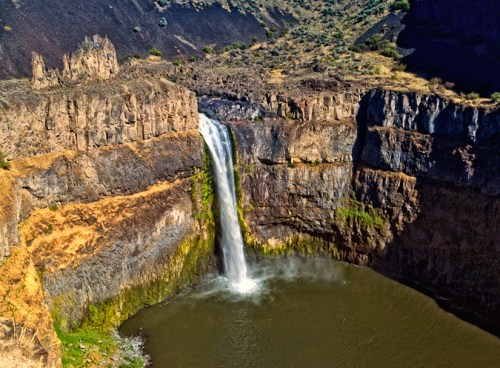
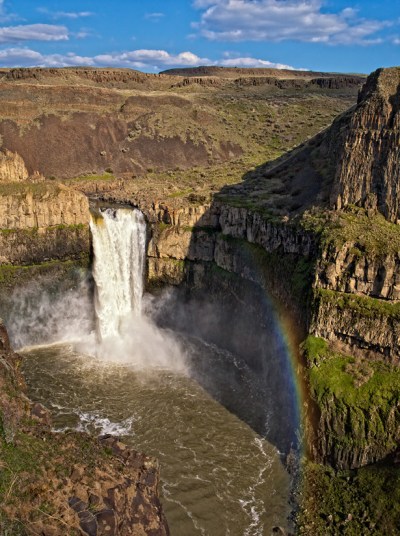
Palouse Falls plunges about 200 feet into a deep pool surrounded by rock. The whole area is actually a deep canyon and thus the necessity of shooting mid -day so the falls and canyon will be lighted as the sun is overhead. This is one of the more difficult falls to shoot and get a good image because the light is tricky and can be very harsh. In addition early in the season the water in the falls looks brown like chocolate milk from the dirt that is being released in the river upstream. Later in the season when the water is clear the falls diminishes in its volume. When the light is right you can see a rainbow in the mist. I have found the best time to photograph is late May and June.

Palouse Falls with Rainbow by Gary Hamburgh - All Rights Reserved

Palouse Falls with Rainbow by Gary Hamburgh - All Rights Reserved

There is also some wildlife in the area that includes marmots, deer and several species of birds. In addition images of the actual canyon itself are interesting and there are several trails in the area for hiking.

I would suggest eating before you go and bring plenty of water because there is very little in the way of civilization in this area. Hopefully, you will take the time for the trip as it can offer a very rewarding photographic experience.


Tips for Aperture Users

Morning Light at the Barn by Gary Hamburgh - All Rights Reserved

Morning Light at the Barn by Gary Hamburgh - All Rights Reserved

I use Aperture in my workflow to manage my images. In a recent article by Scott Bourne three useful tips are given that I use on a regular basis as I work with images. Take a look at Photofocus and add some valuable tools to you workflow in Aperture.

Return to a Favorite Spot and Have Fun

Winn Road Barn in Snow by Gary Hamburgh - All Rights Reserved

Winn Road Barn in Snow by Gary Hamburgh - All Rights Reserved

One of my favorite barns to photograph is near the town of Weston in eastern Oregon. I have photographed it at all times of the day and during all seasons of the year. I have met the Winns who now live on the property where the barn stands. The following  description will provide some history about this beautiful and well preserved structure.

Wind Road Barn in Snow Close by Gary Hamburgh - All Rights Reserved

Wind Road Barn in Snow Close by Gary Hamburgh - All Rights Reserved

From Highway 12 going south toward Weston, take the Winn Road left off the highway. The barn sits in the valley to the right and is visible from the road. Ralph Moon built the barn for about $2500. The owner, George W. Winn hand sawed every board that built the barn in the spring and summer of 1916, using his harvest crew. The lumber was clear grain Douglas fir delivered for $11 per K, the ground was scraped flat,, and a foundation was laid in April. The barn was completed for hay storage by harvest time. Half the barn had 10 stalls for horses and the other half had 25 cow stanchions. The original shake roof lasted over seventy years and the red paint originally used was a mixture of white lead paint with red ochre and linseed oil added: very durable. There are no posts in the entire structure which is now used for storage.

I enjoy photographing this barn from many angles and positions. All the photos in the post were taken on a winter day which is one of my favorite seasons to shoot this barn.

Winn Road Barn in Snow 1 by Gary Hamburgh - All Rights Reserved

Winn Road Barn in Snow 1 by Gary Hamburgh - All Rights Reserved

If you are ever in this area be sure to take the time to view this unique and well preserved structure from the past.

Add “pop” to your images – EFX Color Pro revisited

Red Barn near St. John by Gary Hamburgh - All Rights Reserved

Red Barn near St. John by Gary Hamburgh - All Rights Reserved

Sometimes you capture an image that you like because of the composition but the conditions don’t show the vision that you pictured in your mind. I have found that using EFX Color Pro by Nik software can add some “pop” to an image that otherwise would be very ordinary. I talked about this package in an earlier post but I just want toe reemphasize its usefulness.

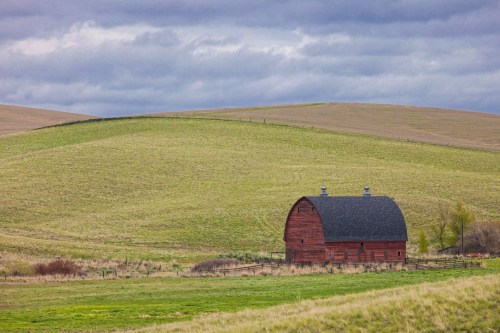
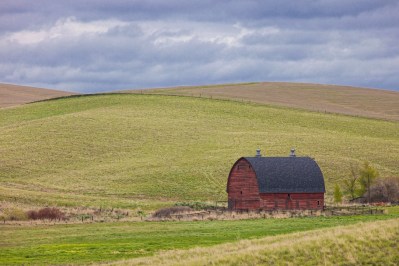
The original image at the top of the page shows the finished image that I had hoped to achieve. I will go through the workflow that I used to create this image. The first photo below shows the image as I captured it in camera. I liked the composition and the basic elements, but I knew there were several things that needed to be done to satisfy my eye.

Red Barn near St. John original

Red Barn near St. John original

First I imported the image into my Aperture library and added a bit of vibrancy and straightened the image slightly. Next I removed the telephone pole in the left side of the image using Photoshop CS3. At that point the image was ready for a little extra “pop” . I used the EFX Color Pro plugin for Aperture in my workflow to help me accomplish this. The first step was to add the Tonal Contrast filter to the image which gave me the result as it appears below.

Red Barn near St. John with tonal contrast filter

Red Barn near St. John with tonal contrast filter

My final step was to add the polarizing filter that is available to give a bit more definition to the clouds. The final image is shown once again below and I think these slight modifications create more impact.

Red Barn near St. John by Gary Hamburgh - All Rights Reserved

Red Barn near St. John by Gary Hamburgh - All Rights Reserved

Remember as you are shooting, always capture the best image you can in camera and then provide slight modifications to add the impact you seek. I have found EFX Color Pro by Nik software to be an extremely helpful package for this purpose.

Diversity in the Palouse

Old Red Barn and Corral by Gary Hamburgh - All Rights Reserved

Old Red Barn and Corral by Gary Hamburgh - All Rights Reserved

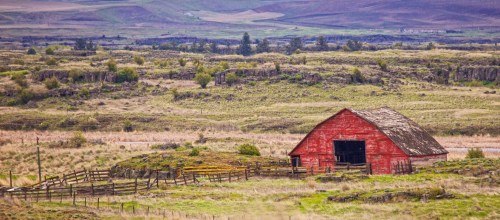
At the mention of the Palouse region of eastern Washington, a picture of rolling hills and wheat fields usually enters our mind. This region is well known for the beautiful patterns and textures that accompany the dry land farming that takes place.

As you become more familiar with the region, you will find that much of the land is used for raising cattle. The lush agricultural fields are left behind for an arid and rocky landscape that is the home to cattle ranches. The barn that is shown at the top of this page is located on a ranch that is ten miles northwest of the small town of St. John. About a mile from where I photographed this barn, I met a rancher and his grandsons as they were herding ten bulls into a field for breeding with about one hundred and fifty cows. He told me the story of how his great grandfather had settled this land in the late 1800′s. His family has lived in the region in the same house for four generations.

Hopefully you will visit this Palouse and experience the tremendous diversity that exists with the land and its inhabitants.